


| Issue |
Europhysics News
Volume 57, Number 1, 2026
Quantum physics
|
|
|---|---|---|
| Page(s) | 9 - 11 | |
| Section | Features | |
| DOI | https://doi.org/10.1051/epn/2026106 | |
| Published online | 16 March 2026 | |
From superconductivity to macroscopic quantum phenomena: a path marked by Nobel Prizes
Centro de Física de Materiales (CFM-CSIC), San Sebastián, Spain and Donostia International Physics Center (DIPC), San Sebastián, Spain
Abstract
Is it possible to create a Schrödinger’s cat in a laboratory - that is, to make a macroscopic object obey the laws of quantum mechanics? The 2025 Nobel Prize in Physics recognizes experiments showing that this is indeed possible, using superconducting electrical circuits.
© European Physical Society, EDP Sciences, 2026
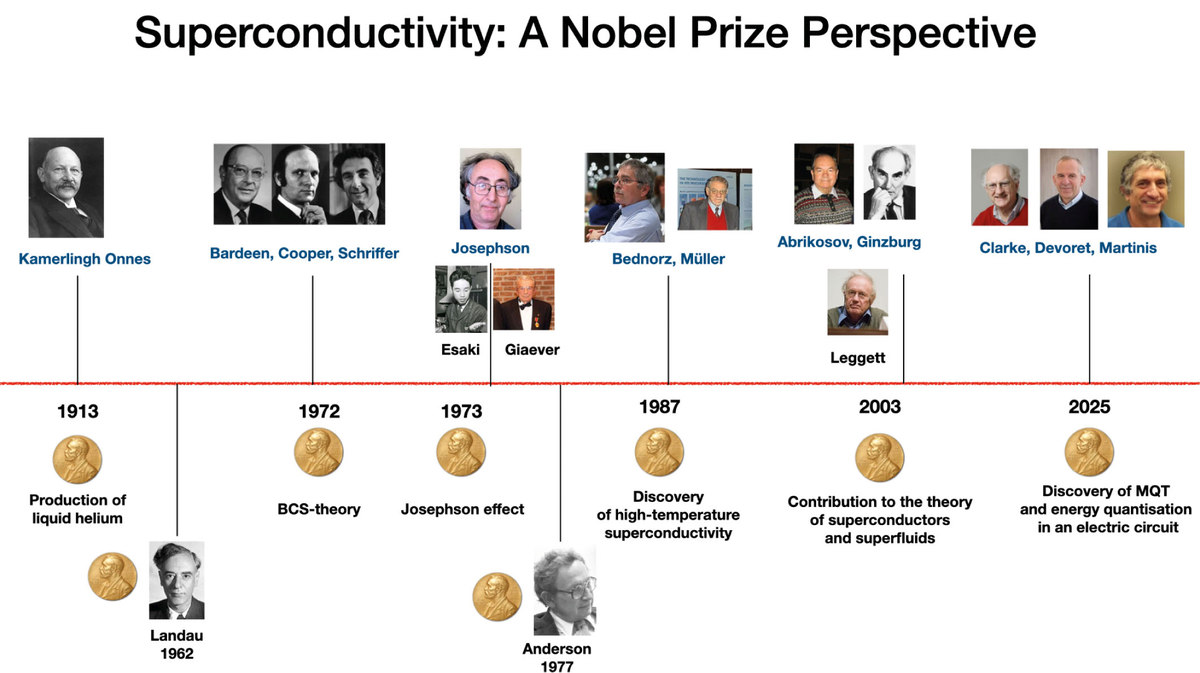
The path to this achievement can be traced through the history of superconductivity marked by key Nobel Prizes (Fig. 1). From the prize awarded to Kamerlingh Onnes for the discovery of superconductivity itself, through the theoretical breakthroughs of Ginzburg, Landau, and Bardeen, Cooper, Schrieffer, and Josephson for theory achievements, to the 2025 laureates - John Clarke, Michel Devoret, and John Martinis - who demonstrated quantum behaviour in macroscopic superconducting electric circuits.
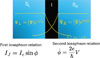 |
FIG 1 Schematic view of a Josephson junction formed by two superconductors (SL, SR) separated by an insulating layer. A supercurrent (IJ), proportional to the sine of the phase difference (φ), can flow without a voltage drop, due to the overlap of the collective electron wave functions. The two Josephson relations are shown below. |
Surely, when Heike Kamerlingh Onnes discovered in 1911 that certain metals lose all electrical resistance below a critical temperature, he could not have imagined that this phenomenon would capture the attention of scientists for more than a century. It also took some time before superconductivity began to be properly understood. A major step forward came in 1950, when Vitaly Ginzburg and Lev Landau proposed an insightful and intuitive phenomenological theory which introduced a complex order parameter Ψ=|Ψ|eiϕ - a kind of pseudo wavefunction - whose squared amplitude represents the density of electrons participating in superconductivity. This simple description already anticipated one of the profounds aspects of the phenomenon: superconductivity is characterized by a global quantum phase shared by all participating electrons, i.e., they act collectively as a single coherent quantum system.
Seven years later, John Bardeen, Leon Cooper, and Robert Schrieffer presented the first microscopic theory of superconductivity, known as the BCS theory. The BCS theory confirms that superconductivity is a macroscopic quantum state in which electrons near the Fermi surface form bound pairs, known as Cooper pairs. Actually, these pairs condense into a single collective state. All superconducting properties - such as zero electrical resistance, perfect diamagnetism, and quantum transport in macroscopic quantum devices - can be understood within BCS theory.
A subsequent fundamental link to the Nobel Prize of 2025 - and another Nobel Prize in this story - was the prediction of the Josephson effect. In 1962, Brian D. Josephson, then a PhD student at the University of Cambridge, predicted that two superconductors separated by a thin insulating barrier could sustain a supercurrent with no applied voltage, and that this current would depend on the macroscopic phase difference, φ=ϕL–ϕR, between the superconductors forming the junction (Fig. 1). In simple terms, this can be understood as the overlap of the two macroscopic “wave functions” of the superconductors, coupled through the tunnelling barrier. Such an overlap leads to a supercurrent, that is a current without dissipation. Josephson also showed that the time derivative of the phase difference is proportional to the voltage across the junction.
Josephson’s predictions were confirmed within a year by P.W. Anderson and J.M. Rowell (1963), and the interest in using the Josephson effect in real devices grew rapidly. It soon became clear that in order to understand the current - voltage characteristics of a Josephson junction, one had to take into account the electrical circuit and electromagnetic environment seen by the junction. In this context, between 1966 and 1968, the so-called RCSJ (Resistively and Capacitively Shunted Junction) model was introduced.
The RCSJ model, which underlies the experiments by Clarke, Devoret and Martinis, represents a Josephson junction and its surrounding circuitry as a simple LCR circuit (Fig. 3a), with the Josephson junction itself acting as a nonlinear inductor L. The resistance R accounts for dissipation when a finite voltage develops across the junction, while C accounts for both the junction’s and circuit’s capacitance. An applied current I is shared by the three branches, providing a complete picture of the junction’s dynamics.
From this simple circuit one can derive the equations for the phase dynamics, recalling that the second Josephson relation connects the voltage across the junction to the time evolution of the phase (Fig. 1). The resulting equation admits a very intuitive mechanical analogy: it is equivalent to the motion of a particle with an effective mass proportional to the capacitance, moving in a one-dimensional tilted “washboard” potential U(ϕ) (Fig. 2b), with the phase difference playing the role of the particle’s position. For example, if the particle is confined in one of the minima of the potential, it remains there, i.e., the phase does not change in time and, according to Josephson’s second relation, this corresponds to a zero-voltage state. As the bias current increases, the tilt of the potential grows (Fig. 2b). When the bias current exceeds Ic - the maximum supercurrent the junction can sustain without dissipation - the particle escapes from the minimum and slides down the potential, producing a finite voltage across the junction. This simple model provides a rather accurate description of the phase dynamics, and consequently of the current–voltage characteristics of Josephson junctions. But how does this classical model relate to quantum mechanics and to the Nobel Prize of 2025?
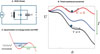 |
FIG 2 (a) Schematic circuit of the RCSJ model describing the dynamics of a Josephson junction. The bias current (I) is distributed among the three branches. (b) Tilted washboard potential. When the “particle” is in a potential minimum, it corresponds to a zero-voltage state. Increasing the bias current (I) increases the tilt, allowing the particle to escape and generates a finite voltage across the junction. (c) Quantization of the junction’s energy levels is analogous to the quantization of a particle in a quantum well. The system’s state can be changed by microwave irradiation. According to quantum mechanics, there is also a finite probability of escape via macroscopic quantum tunneling (MQT). Both properties were demonstrated in the experiments by Clarke, Devoret, and Martinis in the mid-1980s. |
Although the superconducting phase is a collective phase of many Cooper pairs, the RCSJ model treats it as a classical variable. So where does quantum mechanics enter? To answer this question, let us push the analogy a bit further and assume that the particle is trapped in one of the potential wells. Classically, it could escape only with the help of thermal fluctuations, which allow it to hop over the potential barrier. Quantum mechanics, however, offers another route to escape, namely tunnelling.
Already in the late 1960s, Y.M. Ivanchenko and L.A. Zil’berman realized that even when thermal fluctuations are suppressed - e.g., at very low temperatures - the phase may still undergo quantum fluctuations. In the mechanical analogy, this means that the “particle” can escape from a potential minimum by tunnelling through the barrier even at zero temperature. This phenomenon is known as macroscopic quantum tunnelling (MQT), a term coined by Anthony J. Leggett in the late 1970s. The word macroscopic is crucial here, as it recalls that the “position” of the particle in the RCSJ analogy, is nothing but the collective superconducting phase difference across the junction. This single variable emerges from the coherent behaviour of an enormous number of electrons. MQT will result in a transition from a zero to a finite voltage state.
There is another key aspect borrowed from quantum mechanics: when the particle is confined in one of the wells of the washboard potential (Fig. 3B), it no longer has a continuous range of energies but instead has discrete energy levels. Translated back to our circuit, this means that the Josephson junction can reside in different quantized energy states.
These ideas directly inspired John Clarke, Michel Devoret, and John Martinis in designing a carefully controlled experiment to demonstrate the two quantum effects described above. They embedded a Josephson junction in an experimental setup designed to mimic the conditions of the RCSJ model. By biasing the junction with a current below the critical current, corresponding to the zero-voltage state, i.e., the particle being in a minimum of the potential, they could probe the dynamics of the phase in a controlled way. The “escape” of the particle from the potential well was detected as the sudden appearance of a finite voltage across the junction, providing a direct signature of the phase leaving the potential well. By repeating this measurement many times and varying the temperature, they could study the escape rate. At sufficiently low temperatures, the escape rate became essentially temperature independent, in agreement with the predictions for macroscopic quantum tunnelling (MQT), a clear demonstration that the phase behaves as a macroscopic quantum variable.
To further reveal the quantized nature of the phase, they applied microwaves to the junction. When the microwave frequency matched the spacing between the quantized energy levels of the well (Fig. 2c), the escape rate increased resonantly. This provided direct evidence that the macroscopic phase also exhibits discrete energy states, just like a quantum particle in an atom. These experiments unambiguously demonstrated the quantum nature of a macroscopic degree of freedom. In effect, Clarke, Devoret, and Martinis created the first “macroscopic artificial atom”, or, if one prefers, a circuit-level realization of Schrödinger’s cat: a macroscopic object obeying the laws of quantum mechanics.
Their work opened a new field of research. It provided the foundation for later developments such as the Cooper pair box, a device that exploits the variable conjugate to the superconducting phase - the electric charge - ultimately leading to the transmon qubit used in state-of-the-art quantum computers. More broadly, it invigorated the field of mesoscopic physics by demonstrating that a single macroscopic degree of freedom can be coherently manipulated and measured, thereby bridging condensed matter physics and quantum information science.
Beyond its applications, as John Clarke noted in a recent interview, their discovery had technological consequences that could not have been anticipated at the time it was made. It serves as a powerful reminder of the importance of supporting and funding fundamental research, whether or not it leads to immediate technological applications. n
About the Author
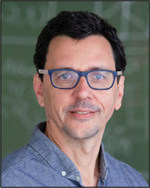
Sebastián Bergeret is a Research Professor at the Materials Phsyics Center in San Sebastian, Spain, where he leads the Mesoscopic Physics Group. He is an expert in the theory of quantum transport, spintronics, and mesoscopic superconductivity.
References
- J. M. Martinis, M. H. Devoret and J. Clarke, Phys. Rev. Lett. 15, 1543 (1985); Phys. Rev. B 35, 4682 (1987) [Google Scholar]
- Anderson P.W. and Rowell J.M., Phys.Rev.Lett. 10, 230 (1963) [Google Scholar]
- Leggett A. J., Prog. Theor. Phys. Supp. 69, 80 (1980) [Google Scholar]
- Ivanchenko, Yu. M. and L. A. Zil’berman, Sov. Phys. JETP 28, 1272 (1969) [Google Scholar]
- V. Bouchiat, D. Vion, P. Joyez, D. Esteve, M. H. Devoret, Physica Scripta T 76, 165 (1998); Y. Nakamura, Yu. A. Pashkin, and J. S. Tsai, Nature 398, 786 (1999) [Google Scholar]
- J. Koch, T. M. Yu, J. Gambetta, A. A. Houck, D. I. Schuster, J. Majer, A. Blais, M. H. Devoret, S. M. Girvin, R. J. Schoelkopf, Phys. Rev. A 76, 42319 (2007); M. H. Devoret and R. J. Schoelkopf, Science 339, 1169 (2013) [Google Scholar]
On the Cooper Box and the Transmon:
- J. M. Martinis, M. H. Devoret and J. Clarke, Phys. Rev. Lett. 15, 1543 (1985); Phys. Rev. B 35, 4682 (1987) [Google Scholar]
- Anderson P.W. and Rowell J.M., Phys.Rev.Lett. 10, 230 (1963) [Google Scholar]
- Leggett A. J., Prog. Theor. Phys. Supp. 69, 80 (1980) [Google Scholar]
- Ivanchenko, Yu. M. and L. A. Zil’berman, Sov. Phys. JETP 28, 1272 (1969) [Google Scholar]
- V. Bouchiat, D. Vion, P. Joyez, D. Esteve, M. H. Devoret, Physica Scripta T 76, 165 (1998); Y. Nakamura, Yu. A. Pashkin, and J. S. Tsai, Nature 398, 786 (1999) [Google Scholar]
- J. Koch, T. M. Yu, J. Gambetta, A. A. Houck, D. I. Schuster, J. Majer, A. Blais, M. H. Devoret, S. M. Girvin, R. J. Schoelkopf, Phys. Rev. A 76, 42319 (2007); M. H. Devoret and R. J. Schoelkopf, Science 339, 1169 (2013) [Google Scholar]
All Figures
|
FIG 1 Schematic view of a Josephson junction formed by two superconductors (SL, SR) separated by an insulating layer. A supercurrent (IJ), proportional to the sine of the phase difference (φ), can flow without a voltage drop, due to the overlap of the collective electron wave functions. The two Josephson relations are shown below. |
| In the text | |
|
FIG 2 (a) Schematic circuit of the RCSJ model describing the dynamics of a Josephson junction. The bias current (I) is distributed among the three branches. (b) Tilted washboard potential. When the “particle” is in a potential minimum, it corresponds to a zero-voltage state. Increasing the bias current (I) increases the tilt, allowing the particle to escape and generates a finite voltage across the junction. (c) Quantization of the junction’s energy levels is analogous to the quantization of a particle in a quantum well. The system’s state can be changed by microwave irradiation. According to quantum mechanics, there is also a finite probability of escape via macroscopic quantum tunneling (MQT). Both properties were demonstrated in the experiments by Clarke, Devoret, and Martinis in the mid-1980s. |
| In the text | |
Current usage metrics show cumulative count of Article Views (full-text article views including HTML views, PDF and ePub downloads, according to the available data) and Abstracts Views on Vision4Press platform.
Data correspond to usage on the plateform after 2015. The current usage metrics is available 48-96 hours after online publication and is updated daily on week days.
Initial download of the metrics may take a while.