


FIG 2
Download original image
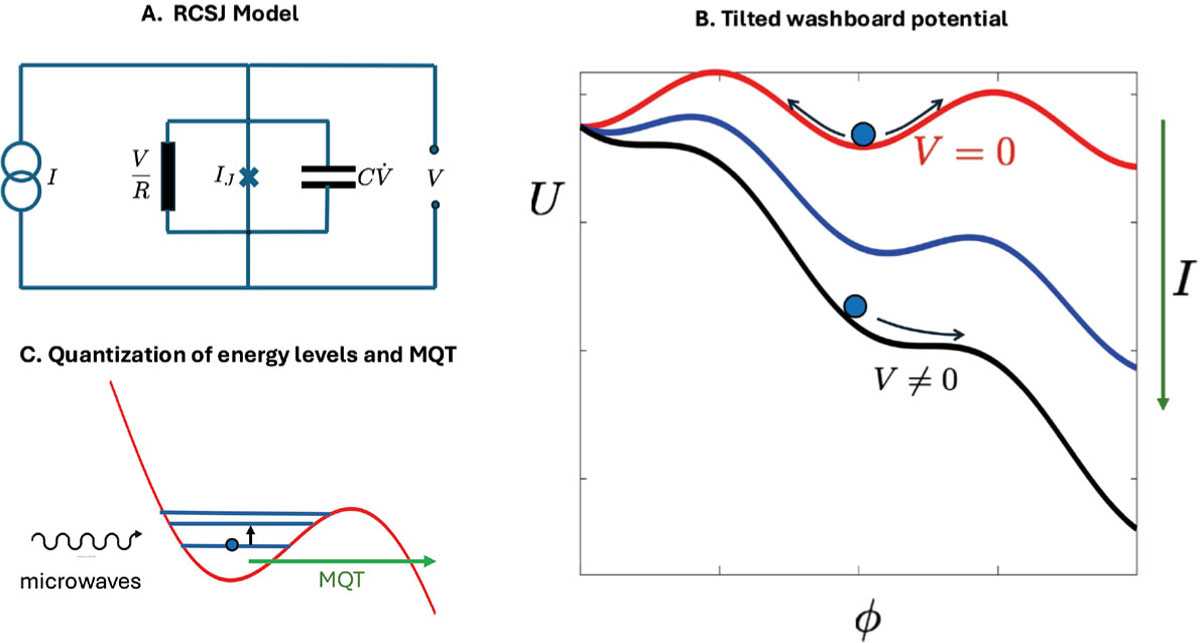
(a) Schematic circuit of the RCSJ model describing the dynamics of a Josephson junction. The bias current (I) is distributed among the three branches. (b) Tilted washboard potential. When the “particle” is in a potential minimum, it corresponds to a zero-voltage state. Increasing the bias current (I) increases the tilt, allowing the particle to escape and generates a finite voltage across the junction. (c) Quantization of the junction’s energy levels is analogous to the quantization of a particle in a quantum well. The system’s state can be changed by microwave irradiation. According to quantum mechanics, there is also a finite probability of escape via macroscopic quantum tunneling (MQT). Both properties were demonstrated in the experiments by Clarke, Devoret, and Martinis in the mid-1980s.
Current usage metrics show cumulative count of Article Views (full-text article views including HTML views, PDF and ePub downloads, according to the available data) and Abstracts Views on Vision4Press platform.
Data correspond to usage on the plateform after 2015. The current usage metrics is available 48-96 hours after online publication and is updated daily on week days.
Initial download of the metrics may take a while.