


| Issue |
Europhysics News
Volume 57, Number 3, 2026
The evolving world of drones
|
|
|---|---|---|
| Page(s) | 16 - 19 | |
| Section | Features | |
| DOI | https://doi.org/10.1051/epn/2026308 | |
| Published online | 08 July 2026 | |
Drone swarms: is the future centralized or decentralized?
1
Eötvös University, Department of Biological Physics
2
CollMot Robotics Ltd
*
This email address is being protected from spambots. You need JavaScript enabled to view it.
Abstract
Drone swarms are disruptively transforming our life. While most scientists envision future drone swarms in decentralized bee-like self-organization, the largest real-world swarms in drone shows or military operations evolved to be centrally controlled. This article examines this discrepancy, comparing advantages, limitations, and practical applications of centralized and decentralized drone operations.
© European Physical Society, EDP Sciences, 2026
With our research team we have spent the last decades developing large autonomous drone swarms inspired by biological self-organization [1], the natural basis of collective behavior observed all around us. We developed reliable decentralized drone control models and demonstrated their stability using 50–100 real outdoor quadcopters and up to 5000 simulated ones in bird-like flocking experiments [2] and dense aerial traffic scenarios [3].
Through our research projects and our strong commitment to bio-inspired systems, we blindly believed from the very beginning that decentralization represented the inevitable and only future of drone swarms. To respond to the significant interest in the scientific concepts and technological capabilities behind our work, we founded a university spin-off in 2015, but the real market demand for large-scale decentralized autonomous drone swarms did not truly arrive ever since in practical applications.
In the meantime, real market opportunities for drone fleets emerged in the entertainment industry, where drone shows became a disruptive new tool for marketing and storytelling at large outdoor events [4]. As a result, we gradually evolved into a drone show company and later became the developers of the open-source drone show and swarm control platform, Skybrush [5]. Since competition in this field primarily focuses on scaling swarm size at minimal cost while delivering precisely choreographed performances, this journey ultimately provided us with extensive practical experience in the centralized control of some of the largest drone swarms ever flown.
Based on this dual expertise, the following discussion compares centralized and decentralized control schemes from the operator’s perspective and explores why fully controlled drone systems have so far gained far wider adoption than autonomous ones.
Decentralized control
Decentralized control means that low-level decisions regarding a drone’s flight and actions are not issued by a central control unit but are instead made by the drone itself based on its own state estimation of the environment, nearby drones, and its own condition [6]. In such systems, drones must be fully autonomous, as their safety depends entirely on their own decision-making.
Decentralization is particularly effective when operators can delegate responsibility to the drones themselves, especially during flight scenarios that require real-time adaptation of trajectories or actions beyond what a human operator could manage alone. In this sense, decentralization can be understood as a form of teamwork with shared responsibilities between humans and robots.
 |
FIG. 1 Drone show at the Malta International Fireworks Festival, 2026 (1000 drones). Credits: Pyroemotions, Malta |
However, in decentralized drone swarm systems, operators must also understand that they define only the “what” of the operation, not the “how”. In truly decentralized systems, the operator provides a high-level mission briefing—describing what to do, what to search for, and how to interact with the environment—while the detailed execution is left to the swarm [7]. Individual drones are not treated as unique agents but as interchangeable units; trajectories are not pre- planned, and only a limited set of global parameters, such as the operational area or preferred flight speed, are shared. The drones then negotiate and coordinate their actual flight plans among themselves in real time.
Note that this mode of operation is only “locally rational” rather than globally optimal, and from a control perspective it is inherently less transparent and predictable. Due to the ambiguity that real-time interactions define system behavior, formally guaranteeing safety, correctness, or regulatory compliance becomes significantly more difficult. These characteristics can also increase the perceived stress level of operators, authorities and customers, and this is particularly true in the broader historical context of commercial drones, where users have been conditioned from the very beginning to view the drone as a service unit fully under their control. Few drone operators are willing to give up this status quo, especially when already facing the increased complexity associated with the transition from operating a single drone to managing entire drone swarms.
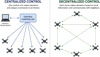 |
FIG. 2 Communication architecture of centralized and decentralized systems. Credits: OpenAI ChatGPT (GPT-5.5). |
Drone-to-drone communication in decentralized systems is often kept broadcast-only, as this minimizes communication delays and naturally favors reliability among nearby drones (communication power decays quickly with distance). This local interaction structure can enhance overall stability and make the system more resilient to communication outages from a ground control station. However, this approach also introduces additional challenges. In broadcast-only communication schemes, explicit acknowledgements are absent, requiring drones to rely more heavily on onboard mechanisms to infer whether their messages have been successfully received and processed by others [8].
A critical demand of decentralized systems is the ability of each agent to take care of itself also in failsafe modes out of the context of normal operations, and this requires an even higher level of self-awareness together with complex failsafe logic. Operators of manually controlled drones often underestimate the complexity of such autonomy, as they naturally compensate for unexpected behavior—such as incorrect altitude, unstable movement, or proximity to obstacles—through their own vision and manual intervention, often without realizing how much intelligent decision-making and situational awareness these corrective actions require.
Decentralized systems are also often described as highly scalable due to the absence of centrally overloaded infrastructure. However, in practice, scaling such systems is one of the most challenging problems, largely due to emergent phenomena arising from the complex and often unpredictable, chaotic dynamics of locally interacting swarm systems. Similarly, they are frequently characterized as robust and redundant, which ensures graceful degradation in case of individual failures. Yet their inherently non-deterministic nature can also work against robustness, and redundancy can, in principle, be achieved within centralized architectures as well.
Centralized control
By centralized control, we refer to a system in which a ground station prepares the flight operation before deployment or adapts it during flight, while continuously specifying exact actions for each drone based on globally collected information. When functioning properly, centralized control is considerably less stressful for the human operator. Centralized control often gets portrayed as “less elegant” than decentralized swarms, but in practice it has a set of very strong, very pragmatic advantages—especially when reliability, certification, and human oversight matter more than biological inspiration [9]. While my admiration and respect for nature and its intriguing complexity will never diminish, there are important details in which we can simply do better than that with technology.
Centralized systems are inherently more predictable because a single entity defines all trajectories and decisions. A central planner can take a full “bird’s-eye view” of the swarm. This allows for globally optimized trajectories, energy usage, coverage patterns, or collision avoidance strategies that individual agents could not easily compute on their own [10]. In such systems, swarm behavior can be fully deterministic in both space and time. Individual drones follow dedicated flight paths that can be monitored reliably. This makes missions repeatable, which is crucial for applications like aerial cinematography, surveying, inspection, or testing, where identical conditions must be reproduced.
Because all decisions originate from one control logic, it is much easier to analyze, test, and certify system behavior. This is a major advantage in aviation contexts, where regulatory compliance and safety guarantees are essential. Centralized control keeps humans firmly in the decision loop. Responsibility, control, and traceability are clearly defined, which is important both legally and operationally. When something goes wrong, it is easier to understand why. While decentralized systems rely on emergent behavior, centralized systems rely on engineered redundancy and explicit fail-safe logic. This can be more predictable in safety-critical environments, even if it introduces a single point of failure at the system level.
A major and many times underestimated advantage of centrally controlled systems is that in this architecture, drones can remain relatively simple, as they do not need to communicate with each other or make complex local decisions. This reduction in onboard complexity can significantly lower unit costs, which becomes a critical advantage when scaling swarm size.
Finally, from a highly practical perspective, while admiring the elegance of decentralization during system design, one must also ask whether such additional complexity is truly necessary. With the current state of technology, centrally controlled systems can already scale to several thousand units while maintaining highly stable communication networks over typical operational distances and achieving centimeter-level navigation. As demonstrated by the world’s largest drone swarms in the context of drone shows, such systems can be implemented and operated with remarkable reliability and simplicity.
Summary
As we can see, both centralized and decentralized control architectures have their own advantages, disadvantages, and appropriate application areas. The main aspects of these control architectures can be seen in Table I.
Brief comparison of centralized and decentralized systems.
Overall, in most practical systems, a hybrid strategy is likely to be the most effective solution. Decentralization should be applied only where it provides clear benefits—such as last-minute collision avoidance, local conflict resolution, truly adaptive cooperative tasks or preprocessing locally sensed data—while the rest of the system should retain as much deterministic centralized control as possible.
About the Author

Gábor Vásárhelyi received his degree in engineering physics from BME, Hungary, in 2003, and earned his PhD in infobionics from PPKE ITK, Hungary, in 2007. He is a researcher at Department of Biological Physics at ELTE and CEO of CollMot Robotics Ltd.
Acknowledgments
Portions of the text were refined with the assistance of OpenAI ChatGPT (GPT-5.5) with translation, language polishing and drafting support.
References
- T. Vicsek & A. Zafeiris, Collective motion. Physics reports 517(3-4), 71 (2012) [Google Scholar]
- B. Balázs, G. Vásárhelyi and T. Vicsek, Journal of the Royal Society Interface 17, 167 (2020) [Google Scholar]
- B. Balázs, T. Vicsek, G. Somorjai, et al., Swarm Intelligence 19(1), 29 (2025) [Google Scholar]
- M. Waibel, B. Keays and F. Augugliaro, Drone shows: Creative potential and best practices (2017). ETH Zurich. [Google Scholar]
- Skybrush, open-source drone show and drone swarm control framework: https://skybrush.io/ [Google Scholar]
- H. Xu, Y. Zhang, B. Zhou et al., Ieee transactions on robotics 38(6), 3374 (2022). [Google Scholar]
- F. Schilling, F. Schiano and D. Floreano, IEEE Robotics and Automation Letters 6(2), 2954 (2021) [Google Scholar]
- Z. Liu, B. Wu, J. Dai, et al., IEEE Transactions on Control of Network Systems 7(4), 1801 (2020). [Google Scholar]
- M. Campion, P. Ranganathan and S. Faruque, Journal of Unmanned Vehicle Systems 7(2), 93 (2018) [Google Scholar]
- J. Alonso-Mora, S. Baker and D. Rus, The International Journal of Robotics Research 36(9), 1000 (2017) [Google Scholar]
All Tables
All Figures
|
FIG. 1 Drone show at the Malta International Fireworks Festival, 2026 (1000 drones). Credits: Pyroemotions, Malta |
| In the text | |
|
FIG. 2 Communication architecture of centralized and decentralized systems. Credits: OpenAI ChatGPT (GPT-5.5). |
| In the text | |
Current usage metrics show cumulative count of Article Views (full-text article views including HTML views, PDF and ePub downloads, according to the available data) and Abstracts Views on Vision4Press platform.
Data correspond to usage on the plateform after 2015. The current usage metrics is available 48-96 hours after online publication and is updated daily on week days.
Initial download of the metrics may take a while.