


| Issue |
Europhysics News
Volume 57, Number 1, 2026
Quantum physics
|
|
|---|---|---|
| Page(s) | 26 - 29 | |
| Section | Features | |
| DOI | https://doi.org/10.1051/epn/2026111 | |
| Published online | 16 March 2026 | |
Perspectives on magnonic computing
Fachbereich Physik and Landesforschungszentrum OPTIMAS, Rheinland-Pfälzische Technische Universität (RPTU) Kaiserslautern-Landau, Erwin-Schrödinger-Strasse 56, 67661 Kaiserslautern, Germany
Abstract
We live in a time of intensifying transformations and innovations in the information technology field. So far, computing power has steadily increased due to miniaturisation, multi-core and graphics processor development, and more. Currently, we are observing that new computing concepts, that go beyond two-state Boolean logic, are considered and implemented. Quantum computing is among the best known of these concepts, but to date neural-like neuromorphic systems such as artificial neural networks and annealers are already widely implemented with large use in artificial intelligence applications.
© European Physical Society, EDP Sciences, 2026
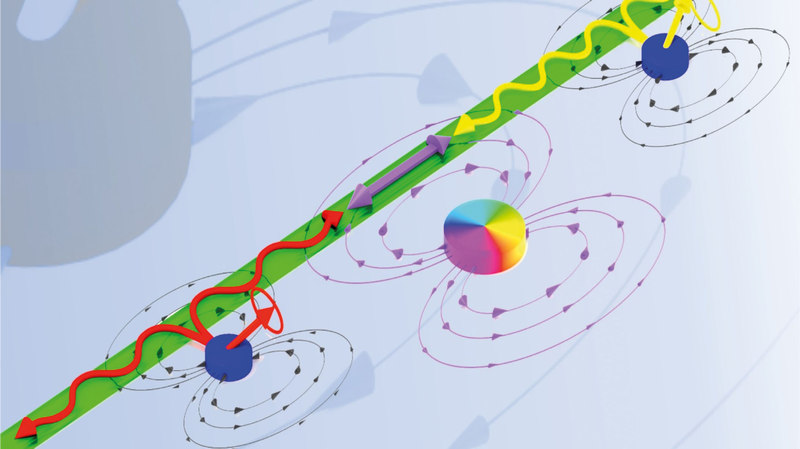
However, with these new advents, a gap opens up between the algorithms and the available hardware. We need to search for new hardware solutions, both in pushing existing technology further forward, as well as searching for radically new concepts.
The currently fast-developing field of magnonics could offer such a new approach. The field is still in the very fundamental domain, but potential applications are increasingly being discussed. We will address the potential and the perspectives of magnonic computing in this article.
Magnonics deals with waves in magnetically ordered materials [1]. They are called spin waves, with their quanta, magnons. These waves exist because of the quantum-mechanical exchange interaction, as well as the dipole-dipole interaction between magnetic dipoles, which are provided by the spins in a magnetic material. Other phenomena, such as a full plethora of magnetic anisotropies, also contribute to the spin-wave properties, making spin-wave-based functionalities extremely versatile and shapeable. Spin waves are highly nonlinear, allowing for low-threshold nonlinear wave formation and interaction. The group velocity is of the order of kilometres per second, comparable to the phonon group velocity. Since it is much smaller than the speed of light, the wavelength can be made very small at electronically addressable frequencies in the GHz range, favouring small structure sizes down to the nanometre range. Nowadays, most magnonic demonstrators are based on ferromagnetic or ferrimagnetic materials using spin waves in the GHz range with wavelengths from micrometres down to several tens of nanometres.
Most wave-based computing concepts build on linear and nonlinear wave interference, wave confinement in waveguide structures, and the formation of wave packets as information carriers [1]. Compared to many other physical systems, magnonics is distinguished by the fact that it enables wave-based computing concepts in a very natural manner. Many concepts developed in the field of integrated and fibre optics can be realised in magnonics, often with the added value of better scalability towards small feature sizes, larger wave interaction strength due to the stronger nonlinear interactions, and low energy consumption. On the other hand, the low group velocity and the damping of magnons do not allow for long-distance transport, and the data processing rate of logic devices working in the GHz range is limited. Working with high-frequency magnons in the THz range, such as those present in antiferromagnetic materials, looks promising with regard to processing speed. The inclusion of hybridized excitations, as produced by coupling to (guided) phonons, holds a lot of still unexplored potential, especially for longer-distance transport [2].
Magnonic wave computing
Many concepts for magnonic wave computing have been presented. Most are based on the excitation and propagation of spin waves – for an overview see, e.g., [1, 3, 4]. An early realised prototype device [5] is a majority gate based on the interference of waves at the three input terminals with phases of either 0 or π to code binary information – see Fig. 1a. The phase at the output terminal is the majority phase of the three input terminals. Using this, and a phase shifter of phase π as an implementation of a NOT gate, all functions of Boolean logic can be performed. From this example, it becomes immediately clear that logic functionalities can be realised with structures much less sophisticated compared to conventional transistor-based logic. Challenges remain to create large functional logic circuits consisting of many of these devices interlinked only in the spin-wave domain [4]. For example, such implementations need to be augmented with spin-wave amplifiers to compensate for losses and to achieve the needed fan-out [1, 4].
 |
FIG 1 Micromagnetic simulations of (a) magnonic majority gate (adapted from [5]), (b) half adder (adapted from [4,6]) which uses two magnonic directional couplers. |
This exemplary early and simple device illustrates several properties of magnonic implementation: First, the concept of linear-wave interference can be easily expanded towards multi-wave interference, the so-called frequency multiplexing approach. Second, for implementation in ferro- or ferrimagnetic materials, such as the currently widely-used material Yttrium-Iron-Garnet [1], the frequencies are in the GHz regime and thus the energy quantum per magnon (1 GHz corresponds to 4.14 µeV) is very low. A half adder (see Fig. 1b) [4], working at room temperature, consumes about 16 million magnons per logic operation, so it has excellent low-power performance in the attojoule range [6]. A major issue still is the energy-efficient conversion of electric signals to magnonic signals and vice versa. Nowadays, this conversion often relies on dynamic magnetic fields generated by antennas carrying microwave currents; however the excitation efficiency is low. Much research is underway to increase the efficiency, e.g., by involving piezoelectric and magnetoelastic or, more generally, multiferroic degrees of freedom [4].
There is no requirement to stick with one-dimensional magnonic waveguide structures. 2D devices have been proposed, which are further enhanced by the availability of caustic radiation effects for magnons. In general, 2D magnon optics is well advanced including Fourier filters, frequency splitters and multiplexers, and more [1]. Potentially, waveguide structures can be realized in 3D [3] and might help to solve the von Neumann interconnectivity bottleneck, see also the Outlook section. The fabrication process is a challenge, but there is no fundamental limit imposed by the physics on which magnonic computation relies.
Magnonic neuromorphic computing
Technologies based on concepts of neuromorphic computing are advancing fast. Out of the many approaches, magnonic techniques could provide pathways to direct hardware implementation for artificial neural networks (ANN). Neurons can be efficiently created using magnonic nonlinearities, e.g., by using nonlinear resonators, and by magnonic bistabilities [7]. Both provide nonlinear activation functions, i.e., they emit magnons at their output only when a certain input amplitude is overcome. Using different spin-wave frequencies, magnetic ground states or bias fields, these activation functions can be manipulated, which is an important feature to adapt the magnonic ANN during its training process or to reconfigure it for new tasks. The synaptic connections between the magnonic neurons are provided by magnonic transport. They have the functionality of synaptic weights – during the training process, they can be configured by many means, such as using magnetic memory cells or tuneable amplifiers. A more advanced approach in this context is the combination of magnonic networks with spintronic auto-oscillators, which have already been successfully used as artificial neurons, see Fig. 2. In addition to controllable nonlinearity, this platform offers high interconnectivity of the neurons, since spin-wave frequency multiplexing can be used.
A variant of neuromorphic computing is reservoir computing – here, a recurrent neural network maps input signals into higher-dimensional computational spaces through the dynamics of a fixed, non-linear system called a reservoir. Compared to traditional ANN, these systems are easier to realize since they do not change the weights of the individual connections. One interesting example, which does not rely on data transport in real space via magnonic currents, is to use nonlinear interactions of magnons and transport in reciprocal space (“modal multiplexing”) to demonstrate functionalities such as pattern recognition [8]. The challenge of this approach is the comparably difficult readout of the computational result from the reciprocal space. Other magnonic reservoir approaches use spin-wave-based ring oscillators with time-multiplexing, which are comparably slower but benefit from an efficient connection to the electronic periphery [9].
Magnonic systems for optimisation tasks
An important class of computing applications consists of optimisation tasks. Among them are many problems, which scale unfavourably with system size when being realized with conventional logic, especially hard combinational optimization problems. Annealing techniques provide a pathway to their solution. Here, the problem is mapped onto finding the (absolute) minimum of an objective function.
Ising machines provide an elegant solution. They are based on a combinatorial approach: each state of an Ising machine – often called a “spin” for obvious reasons – is binary, and the challenge is that each state must interact with many other states. A matrix of the interaction strengths between all possible spin combinations represents the input. The Ising machine delivers the solution to the problem, which is the respective wavefunction. This has been realized in optics using optical delay lines and nonlinear interactions. Recently, a magnonic version has been demonstrated, which has the charm of a small footprint due to the rather slow group velocity of magnons [10]. Figure 3 shows the setup and the principle of function. For applications like this, the inherent advantages of a magnonic implementation, such as nonlinearity and small group velocities, come into their own.
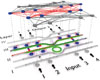 |
FIG 2 Artificial neuronal network based on spintronic auto-oscillators (blue) connected by coherent spin waves, which are emitted into nanoconduits (green). |
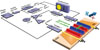 |
FIG 3 Schematics of a hybrid magnonic-microwave Ising machine, which uses the phase of spin-wave pulses in a YIG delay line to represent the state of the annealer system [10]. |
Outlook
On the bottom line, regarding the balance of unique favourable properties in a magnonic environment and also considering existing disadvantages, magnonics could prove to be an excellent option for computing in the next generations. The concepts are under development. Apart from low power consumption and the realisation of specific devices, where the advantage of coherence is immediately evident (such as frequency splitters and combiners), we see a significant advantage when it comes to advanced computation schemes, especially those which benefit most from a wave-based approach.
Magnonics is currently advancing very fast. Many novel concepts have been reported, such as the use of magnonic Bose-Einstein condensates and transport mechanisms based on them [1, 11]. Magnonics can be implemented in the quantum regime [1, 2], but more likely applications in the classical regime are foreseen due to favouring room-temperature operation.
In particular, magnonics is very flexible to adapt, if it comes to new challenges. We would like to conclude with a simple example: if large-scale neuromorphic computing is considered, we are faced with the connectivity problem – in the human brain each neuron is connected to 10 000 others via synapses. Such a structure can only be realized in three-dimensional hardware. Out of the foreseeable technologies, magnonics might present here the best chances to provide a platform for realization. In the long run, it might become a major direction to develop such 3D-magnonic concepts. n
About the Authors

Burkard Hillebrands is a senior professor of experimental physics at RPTU University Kaiserslautern-Landau, where he has established a research group addressing experimental magnetism, in particular magnonics.

Philipp Pirro is a junior professor in experimental physics at RPTU University Kaiserslautern-Landau, where he develops a new spintronic platform for brain-inspired computing that links spintronic neurons via spin waves.

Alexander A. Serga is a senior research associate at RPTU University Kaiserslautern-Landau. He is primarily interested in experimental studies of nonlinear spin-wave dynamics and macroscopic quantum states in magnon systems.
References:
- P. Pirro, V. I. Vasyuchka, A. A. Serga, and B. Hillebrands, Nat. Rev. Mater. 6, 1114 (2021) [Google Scholar]
- Y. Li, W. Zhang, V. Tyberkevych, W.-K. Kwok, A. Hoffmann, and V. Novosad, J. Appl. Phys. 128, 130902 (2020) [Google Scholar]
- G. Gubbiotti et al., J. Phys.: Condens. Matter 37, 143502 (2025) [Google Scholar]
- A. Mahmoud, F. Ciubotaru, F. Vanderveken, A. V. Chumak, S. Hamdioui, C. Adelmann, and S. Cotofana, J. Appl. Phys. 128, 161101 (2020) [Google Scholar]
- S. Klingler, P. Pirro, T. Brächer, B. Leven, B. Hillebrands, and A. V. Chumak, Appl. Phys. Lett. 106, 212406 (2015) [Google Scholar]
- Q. Wang, M. Kewenig, M. Schneider, R. Verba, F. Kohl, B. Heinz, M. Geilen, M. Mohseni, B. Lägel, F. Ciubotaru, C. Adelmann, C. Dubs, S. D. Cotofana, O. V. Dobrovolskiy, T. Brächer, P. Pirro, and A. V. Chumak, Nat. Electron. 3, 765 (2020) [Google Scholar]
- Q. Wang, R. Verba, B. Heinz, M. Schneider, O. Wojewoda, K. Davídková, K. Levchenko, C. Dubs, N. J. Mauser, M. Urbánek, P. Pirro, and A. V. Chumak, Sci. Adv. 9, eadg4609 (2023) [Google Scholar]
- L. Körber, C. Heins, T. Hula, J.-V. Kim, S. Thlang, H. Schultheiss, J. Fassbender, and K. Schultheiss, Nat. Commun. 14, 3954 (2023) [Google Scholar]
- S. Watt, M. Kostylev, A. B. Ustinov, and B. A. Kalinikos, Phys. Rev. Appl. 15, 64060 (2021) [Google Scholar]
- A. Litvinenko, R. Khymyn, V. H. González, R. Ovcharov, A. A. Awad, V. Tyberkevych, A. Slavin, and J. Åkerman, Commun. Phys. 6, 227 (2023) [Google Scholar]
- M. Mohseni, V. I. Vasyuchka, V. S. L’vov, A. A. Serga, and B. Hillebrands, Commun. Phys. 5, 196 (2022) [Google Scholar]
All Figures
|
FIG 1 Micromagnetic simulations of (a) magnonic majority gate (adapted from [5]), (b) half adder (adapted from [4,6]) which uses two magnonic directional couplers. |
| In the text | |
|
FIG 2 Artificial neuronal network based on spintronic auto-oscillators (blue) connected by coherent spin waves, which are emitted into nanoconduits (green). |
| In the text | |
|
FIG 3 Schematics of a hybrid magnonic-microwave Ising machine, which uses the phase of spin-wave pulses in a YIG delay line to represent the state of the annealer system [10]. |
| In the text | |
Current usage metrics show cumulative count of Article Views (full-text article views including HTML views, PDF and ePub downloads, according to the available data) and Abstracts Views on Vision4Press platform.
Data correspond to usage on the plateform after 2015. The current usage metrics is available 48-96 hours after online publication and is updated daily on week days.
Initial download of the metrics may take a while.