


| Issue |
Europhysics News
Volume 57, Number 3, 2026
The evolving world of drones
|
|
|---|---|---|
| Page(s) | 13 - 15 | |
| Section | Features | |
| DOI | https://doi.org/10.1051/epn/2026307 | |
| Published online | 08 July 2026 | |
Design of Autonomous Drones
University of California, Berkeley, USA
Abstract
Drones are fundamentally changing fields such as transportation, environmental monitoring, and warfare [1]. Keys to their widespread use is their increasing levels of autonomy and their low cost. In this feature, we give insights into how autonomous drones are designed and where the technology is headed.
© European Physical Society, EDP Sciences, 2026
What is a drone?
Modern aerial robots (commonly known as “drones”) are tightly integrated physical systems in which structure, propulsion, sensing, computation, and control must all work together reliably to achieve autonomous flight.
They come in many different shapes and sizes, but all share the basic design principles and components. The two most common types of drones are multirotors and fixed-wing aircraft, the main difference between the two being how the vertical force needed to counteract gravity is produced. In the case of multirotors, thrust is produced by multiple rotating propellers (typically, 4 or more), while in the case of fixed-wing drones it is produced by a wing translating in air at high speed.
While full-scale helicopters offer similar vertical capabilities to multirotors, they are rare at smaller scales due to their high mechanical complexity – specifically the swash-plate rotor linkages. Multirotors replace these complex mechanical parts with electronics and algorithms, a trade-off that scales more favorably in terms of cost and reliability.
Multirotors and fixed-wing drone designs are motivated by different needs: the ability to hover in place and high maneuverability in the first case, long range, flight time, and speed in the second. Hybrid designs combining the two design principles exist, enabling Vertical Take-Off and Landing (VTOL) capabilities as well as long range flight. Fig. 2 shows a quadcopter, one of the most common drone designs, with the fundamental structural, actuation and autonomy stack components.
 |
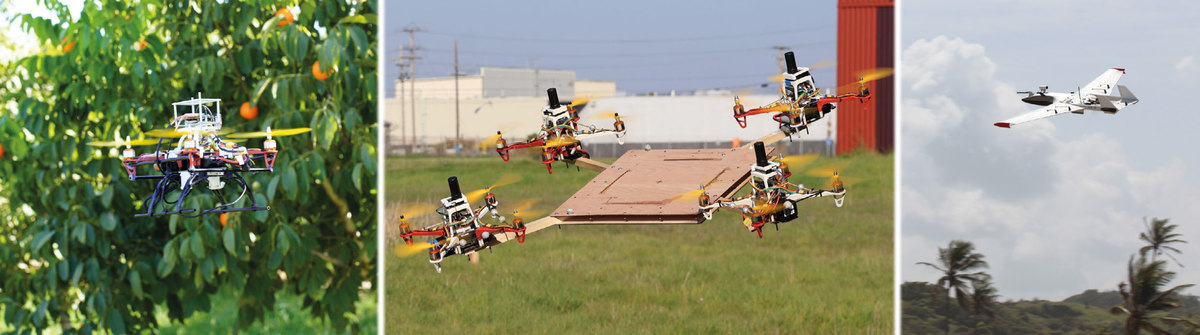
FIG. 1 Drone examples. Left: a custom-assembled research quadcopter autonomously coating a solar panel (from [2]). Right: a fixed-wing drone for tornado monitoring (from [3]). The quadcopter maneuverability and ability to hover enable precise navigation in cluttered spaces. The fixed-wing energy efficiency enables long range missions. |
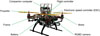 |
FIG. 2 Diagram of a custom research quadcopter and its main components. |
At its core, a quadcopter has four motors with parallel axes and four propellers – two spinning clockwise and two counterclockwise. The motors are driven by Electronic Speed Controllers (ESCs), which convert lowlevel logic signals from the flight controller into three-phase alternating current (AC) signals modulating the motor angular velocity. The main power source is typically a Lithium-polymer battery, owing to these batteries’ high power density.
The flight controller is the main circuit board processing onboard sensor measurements and running high-frequency (but typically low-complexity) feedback control algorithms. A typical flight stack may include:
Inertial sensors – Rate gyroscopes and Accelerometers: Essential for measuring angular velocity and linear proper acceleration.
GPS: Providing the spatial telemetry required for global positioning.
Higher-level autonomy sensors, such as cameras or LiDAR.
Typically, the use of high-throughput sensors such as cameras and LiDAR requires more computationally-intense algorithms, which require the addition of a more powerful companion computer onboard.
Design trade-offs
Drone designs are typically a compromise between competing design objectives, such as endurance, agility, robustness, and cost. The main parameter affecting a drone’s performance is its mass. Reducing the total mass usually leads to improvements towards different design objectives at the same time.
In applications where flight time or range are the main objectives, such as environmental monitoring or payload transportation, efficiency and power consumption are the main aspects to optimize. Central to this is, for example, the relationship between propeller diameter and propulsive efficiency. All else being equal, larger propellers are more energy efficient than smaller propellers – the same momentum flux over a larger propeller disk area leads to lower induced air velocity and thus less power.
The battery mass is proportional to the stored energy, however, increasing the battery size does not necessarily increase flight time. For a given vehicle, there is an optimal value of battery mass beyond which the energy cost of carrying the additional weight outweighs the added capacity, causing total flight time to decrease.
In applications where speed and maneuverability are the primary objectives – such as drone racing – the design is dictated by rotational inertia and actuator authority. Minimizing the vehicle’s inertia allows for higher angular accelerations. The drive toward low inertia inherently favors compact airframes, which offers the secondary benefit of reduced aerodynamic drag when in forward flight, thereby increasing cruise speed. High thrust-to-weight ratio and actuator authority enable the drone to sustain aggressive aerobatic maneuvers and produce high accelerations.
In situations requiring precise control, such as landing or payload pick-up and drop-off, robustness to disturbances (e.g., wind gusts) is the main performance metric. In this case, higher mass and inertia make a system less sensitive to external forces, but may also reduce actuator effectiveness (due e.g. to smaller margins from saturation). Control authority is, in general, a crucial aspect for robustness. Robustness to collisions is another aspect of practical interest, for which a typical approach is adding an outer protective structure to the vehicle [4].
These general design principles can be extended to specific application-driven needs. Interesting examples are morphing drones, which are able to change their shape based on the desired operating regime, and switch on the fly between a more agile and a more robust configuration.
In general, drone design has a deep interplay with the autonomy stack. Sensor placement affects the system inertia as well as localization performances. Similarly, actuator placement affects mass properties as well as control authority and robustness to disturbances. Further, a smart morphology design can drastically simplify the control algorithms, for instance, adding an external collision-resilient structure to a drone allows to simplify collision avoidance algorithms.
Automated design
Autonomous drone design is a complex multi-objective optimization problem, requiring a holistic, system-level approach. Autonomy necessitates a hardware-software co-design strategy where every component is tightly integrated, and enables rapid development cycles unconstrained by the safety requirements of human-on-board aviation. Unlike traditional aerospace engineering – often having decade-long development timelines – autonomous drones leverage rapid prototyping, high-fidelity physics simulations, and advanced control algorithms to achieve fast design iterations and testing. Consequently, drones are evolving into bespoke tools that can be tailored to the specific requirements of a given mission.
This design shift raises a fundamental question for the future of the ecosystem: can modern optimization and machine learning frameworks automate the synthesis of task-specific drone designs? [5,6,7] By treating the design process as an end-to-end pipeline – generating candidate architectures, testing and discarding sub-optimal configurations via simulation, and autonomously validating the best performing designs in the real world – we can drastically compress the design cycle. Such an automated paradigm would not only optimize performance but accelerate the deployment of autonomous systems into increasingly more complex and unstructured environments.
About the Authors

Carlo Bosio is a PhD Student in at UC Berkeley. His research interests are in robotics, optimization, and computational design. He received a BSc and MSc in Mechanical Engineering from the University of Pisa, Italy.

Mark Mueller is an Associate Professor of Mechanical Engineering at UC Berkeley. His research interests include aerial robotics and flight autonomy. He received his B.Eng from the University of Pretoria, South Africa; and MSc/DrSc from the ETH Zurich, Switzerland.
References
- T. Pultarova, “Rise of the Autonomous Attack Drones.” IEEE Spectrum (Apr 2026) [Google Scholar]
- D. Jacquemont et al., “Autonomous Close-Proximity Photovoltaic Panel Coating Using a Quadcopter.” arXiv preprint arXiv:2509.10979 (2025) [Google Scholar]
- Frew, Eric W., et al. Journal of Field Robotics 37.6, 1077 (2020) [Google Scholar]
- J. Zha et al., IEEE/ASME Transactions on Mechatronics 29.5, 3449 (2024) [Google Scholar]
- F. Bergonti et al., “Co-design optimisation of morphing topology and control of winged drones.”2024 IEEE International Conference on Robotics and Automation (ICRA). IEEE (2024) [Google Scholar]
- A. Zhao et al., “Automatic co-design of aerial robots using a graph grammar.” 2022 IEEE/RSJ International Conference on Intelligent Robots and Systems (IROS). IEEE (2022) [Google Scholar]
- C. Bosio and M. W. Mueller. “Automated layout and control Co-design of robust multi-UAV transportation systems.” IEEE Robotics and Automation Letters (2025) [Google Scholar]
All Figures
|
FIG. 1 Drone examples. Left: a custom-assembled research quadcopter autonomously coating a solar panel (from [2]). Right: a fixed-wing drone for tornado monitoring (from [3]). The quadcopter maneuverability and ability to hover enable precise navigation in cluttered spaces. The fixed-wing energy efficiency enables long range missions. |
| In the text | |
|
FIG. 2 Diagram of a custom research quadcopter and its main components. |
| In the text | |
Current usage metrics show cumulative count of Article Views (full-text article views including HTML views, PDF and ePub downloads, according to the available data) and Abstracts Views on Vision4Press platform.
Data correspond to usage on the plateform after 2015. The current usage metrics is available 48-96 hours after online publication and is updated daily on week days.
Initial download of the metrics may take a while.