Practical limits for detection of ferromagnetism (Vol. 42, No. 4)
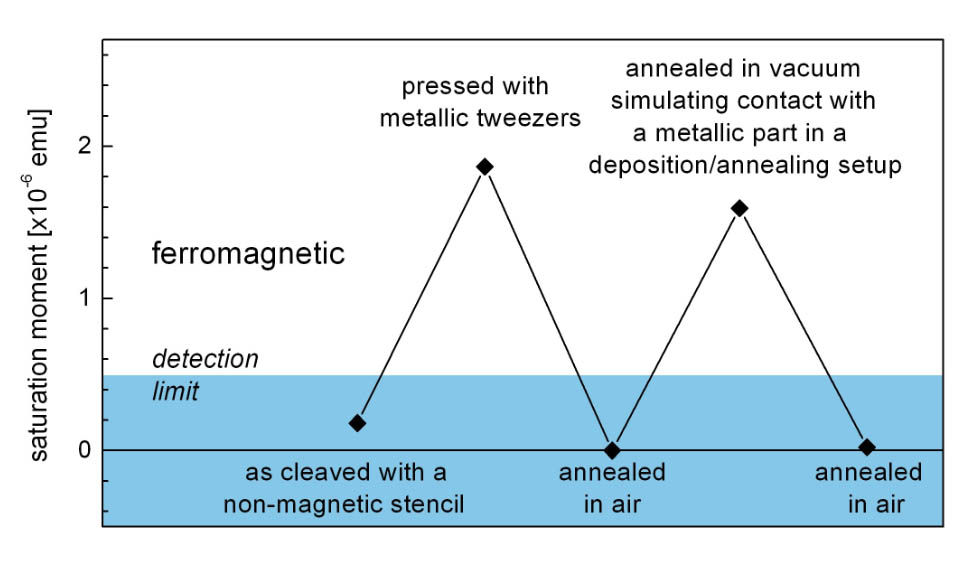 Ferromagnetic saturation moment of a ZnO substrate measured in five consecutive stages, exemplifying two of the most common sources of ferromagnetic contamination and showing a type of reversibility upon annealing under different atmospheres, which is often observed in some of the recently discovered nanomagnets mentioned in the text (the detection of ferromagnetism below 5 10-7 emu is hindered by setup-related artefacts).
Over the last ten years, signatures of room-temperature ferromagnetism have been found in thin films and nanoparticles of various materials that are non-ferromagnetic in bulk. The implications of such high temperature ferromagnetism are in some cases so extraordinary, e.g. dilute magnetic semiconductors (DMS) with carrier-mediated ferromagnetism well above room temperature would revolutionize semiconductor-based spintronics, that they triggered an enormous volume of materials research and development. However, the magnetics community soon started realizing the dangers of measuring the very small magnetic moments of these nanomagnets (nanometer sized materials with nano-emu magnetic moments). Pushing state-of-the-art magnetometers to their sensitivity limits, where extrinsic ferromagnetic signals originating from magnetic contamination and measurement artefacts are non-negligible, these new nanomagnets raise a number of challenges to magnetometry techniques and, most of all, to its users' methods and procedures. While new nanomagnets continue being "discovered" based on magnetometry measurements, the general opinion is moving towards the notion that finding a signature of ferromagnetism by means of magnetometry, i.e. a magnetic hysteresis, is only necessary but not sufficient to claim its existence.
Through an extensive analysis of various materials subject to different experimental conditions, the authors aim at re-establishing the reliability limits for detection of ferromagnetism using high sensitivity magnetometry. The paper provides a roadmap describing how extrinsic ferromagnetism can be avoided or otherwise removed, its magnitude when such optimum conditions cannot be guaranteed, and to what extent its characteristics may or may not be used as criteria to distinguish it from intrinsic ferromagnetism.
Practical limits for detection of ferromagnetism using highly sensitive magnetometry techniques
L.M.C. Pereira, J.P. Araújo, M.J. Van Bael, K. Temst and A. Vantomme, J. Phys. D: Appl. Phys. 44, 215001 (2011)
[Abstract]