


| Issue |
Europhysics News
Volume 57, Number 2, 2026
Education in the age of the AI
|
|
|---|---|---|
| Page(s) | 20 - 22 | |
| Section | Features | |
| DOI | https://doi.org/10.1051/epn/2026211 | |
| Published online | 29 May 2026 | |
The Generative AI-inquiry cycle
Abstract
Generative AI offers various opportunities to improve physics education. However, there are also several non-obvious challenges when integrating generative AI into physics classes and lab courses, such as low cognitive activation, unreflected acceptance, and metacognitive laziness. In this overview, we present three examples for physics lab courses, in which generative AI integrated at different points into existing sequence of inquiry-based learning (Pedaste et al., 2012).
© European Physical Society, EDP Sciences, 2026
Pedaste and collegues (2012) describe the classical inquiry-based learning cycle as consisting of five steps: (1) Orientation, in which learners are introduced to the topic and the learning challenge, (2) Conceptualization, in which learners develop the research questions and hypotheses, (3) Investigation, in which learners experiment, collect data, observe a phenomenon, analyse and interpret the experimental data, (4) Conclusion, in which learners identify relationships in data, refine theoretical assumptions and draw conclusions, and (5) Discussion, in which learners share and discuss the outcomes, reason, and reflect on their findings. The examples we present show how different aspects of this cycle can be enhanced by the use of generative AI.
The first example redefines the classical inquiry steps (1) and (2) by allowing teachers and students to create customized physics simulations using generative AI from scratch. The second example uses smartphone sensors and enhances step (3) of the inquiry cycle using generative AI to introduce students to more advanced data analysis techniques. The third example supports the steps (4) and (5). This example uses a pre-prompted generative AI agent to stimulate students’ interpretation of findings and experimental observations by asking questions to students and providing feedback to their answer.
Note that in each case, it is essential that students are not overwhelmed by the use of GAI or that students do not offload learning-relevant tasks to the GAI. To prevent this, Kuhn et al. (2026) suggested the AIRIS framework (Activate-Inquire-Reflect-with Intelligent Support) which ensures students’ engagement and preserves epistemic practices in physics experimentation.
Example (Orientation & Conceptualization): Physics Simulation using generative AI
In our prototypical example, this design phase is implemented as a browser-based simulation of free fall with quadratic air resistance in 1D, described by:

A single, detailed prompt specifies (i) the physical model, (ii) the interaction design, and (iii) the visual layout. To align the simulation with hypothesis-driven exploration, the prompt requests adjustable parameters (e.g., m, ρ, A or drag coefficient CW), physically meaningful defaults, and transparent SI units throughout. It also allows an optional parachute stage to support hypotheses about transitions between two terminal velocities.
Crucially, the prompt defines the user interface and didactic affordances, including a control panel with sliders and input fields, a canvas animation showing the falling object with force arrows for weight FG and drag FD (with arrow lengths scaled to computed forces), and live plots of v(t) and y(t) with labelled axes, units, and a clean, user-friendly design [6]. The result is a single self-contained HTML file that runs locally in any browser without installation, enabling rapid deployment in class, while allowing experimental runs to be downloaded locally as CSV files for further analysis (see Fig. 1).
 |
FIG 1 Interface of a simulation to inquire concepts related to friction developed using generative AI. |
In Orientation, the teacher frames the topic and the learning challenge using the phenomenon and the interactive representation. In Conceptualization, students develop research questions and hypotheses and translate them into testable simulation specifications. They decide which variables to vary, what to hold constant, and which observable outputs (force arrows, v(t), y(t)) should confirm or contradict their expectations. This makes modelling assumptions explicit and turns hypotheses into actionable specifications before any data collection begins.
Example (Deeper Investigation): Smartphone experiments with generative AI
Smartphones have evolved into mobile mini labs: with built-in sensors such as accelerometers, microphones, GPS, or LiDAR, they can capture a wide range of physical data (Kuhn & Vogt, 2022). Their widespread availability, intuitive usability, and the ability to conduct experiments spontaneously make them suitable measurement tools in school contexts. Studies indicate that their classroom use increases motivation and strengthens both physics self-concept and conceptual understanding (e.g., Becker et al., 2020). Combining smartphone experiments with AI-based analysis leads to the concept of AI-Supported Mini-Labs and allows a deeper analysis of the measurement data (Kuhn et al., 2026).
Multimodal AI systems add new possibilities for data analysis. They perform routines such as smoothing, numerical integration, regression, or statistical evaluation—tasks that often exceed students’ mathematical skills. An experiment on free fall with air resistance illustrates this approach. Students analyze their own measurement data and directly compare them with theoretical predictions. No additional modeling software is required. Using a multimodal AI system (here Gemini 3 Thinking), data analysis, modeling, and comparison can be conducted within a single tool. This simplifies the entire process—from experiment to evaluation to model construction—and makes it more accessible. The downloadable prompts in the issue’s download section accompany the article and provide a description of the experiment as well as the generated results (see Fig. 2).
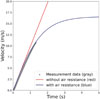 |
FIG 2 Comparison of analyzed measurement data with theoretically modeled curves. |
The dataset can only be described satisfactorily when air resistance is included. Students would typically be unable to perform the necessary numerical integration or solve differential equations independently.
In sum, combining smartphones as experimental tools with generative AI as a multimodal assistance system offers a promising pathway for individualized physics learning and more advanced analyses at university level (Kuhn et al., 2026). However, empirical evidence for positive learning effects is still required. Students must also learn to use these tools critically and reflectively, developing AI-related interdisciplinary communication competence.
Example (Conclusion and discussion): Reflection and Feedback during experimentation
In quantum physics, learners frequently encounter profound conceptual difficulties including making sense of counterintuitive quantum concepts. Through the combined use of holograms to visualize otherwise inaccessible aspects of quantum physics and generative AI, instructional support can be effectively realized in such a complex inquiry-based learning environments, as illustrated in the following example:
Figure 3 illustrates an experimental setup through which the BB84 protocol for quantum cryptography can be understood by means of an analogy experiment. The experiment involves three parties: Alice, who encodes key bits (0 and 1) in different bases (+ and ×); Bob, who receives and measures the bits sent by Alice; and Eve, who attempts to intercept the key bits in such a way that her presence remains undetected by Alice and Bob.
 |
FIG 3 Screenshot of the learning application showing the components of the basic experimental setup (cf. Thorlabs, n.d.) arranged on the table. In the enhanced version presented here, additional virtual overlays visualize otherwise inaccessible photon states and experimental parameters. |
The redesign of the commercially available kit described here enhances conceptual accessibility by extending the original setup in two key ways [7]. First, complex quantum-mechanical states are visualized through holographic projections that are directly integrated into the experimental setup and viewed through specialized glasses. Second, the system enables interactive verbal engagement with a generative AI. Through this combination, students receive individualized feedback that supports them during discussion and conclusion in refining their understanding of the underlying processes and the quantum-mechanical concepts involved.
An initial study (for detailed results see Coban et al, 2025) showed significant improvements in students’ performance after feedback from generative AI compared to a condition without generative AI. Furthermore, an analysis of eye-tracking data collected during interactions with the AI revealed that the generated feedback systematically directed learners’ visual attention toward the relevant components of the experimental setup.
Summary
In these three examples, we have shown that in comparison to classical inquiry, the integration of generative AI into inquiry-based learning offers a personalized pathway for orientation and conceptualization, a deeper analysis of measurement data, and enhanced engagement and discussion. With careful design, integration of generative AI creates a meaningful augmentation of epistemic practices and stimulates a deeper engagement with the content, thereby improving the quality of education.
About the Authors

Stefan Küchemann leads the group on artificial intelligence in physics education at the Chair of Physics Education at LMU Munich. His work focuses on understanding learning processes and personalizing learning environments using AI.

Patrik Vogt is a Professor of Physics Education at the University of Education in Heidelberg. He specialises in smartphone-based experiments and the AI-supported analysis of measurement data, with the aim of promoting data literacy, modelling skills, and a deeper understanding of physics.

Yavuz Dinc is a PhD researcher at LMU Munich focusing on eye-tracking and AI-driven adaptive learning systems in education.

Christoph Hoyer is a junior research group leader at the Chair of Physics Education at LMU Munich. His work focuses on how physics learning can be enhanced through technologies such as augmented and virtual reality.

Jochen Kuhn heads the Chair of Physics Education in the Faculty of Physics at LMU Munich, Germany. His research focuses on multiple representations in multimedia learning as well as on artificial intelligence in STEM education and eye-tracking studies.
References
- S. Becker, P. Klein, A. Gößling & J. Kuhn, Zeitschrift für Didaktik der Naturwissenschaften 26(1), 123 (2020) [Google Scholar]
- A. Coban, D. Dzsotjan, S. Küchemann, J. Durst, J. Kuhn & C. Hoyer, EPJ Quantum Technology 12(1), 15 (2025) https://doi.org/10.1140/epjqt/s40507-025-00310-z [Google Scholar]
- J. Kuhn, D. J. Rakestraw, S. Küchemann & P. Vogt, It’s Not The Plane — It’s The Pilot: A Framework for Cognitive-Activated AI-Augmentation to Avoid the Boiling Frog Problem (2026). arXiv:2601.13812. [Google Scholar]
- J. Kuhn & P. Vogt (Hrsg.), Smartphones as Mobile Minilabs in Physics. Edited Volume Featuring more than 70 Examples from 10 Years The Physics Teacher-column iPhysicsLabs (2022). Cham: Springer Nature Switzerland AG. [Google Scholar]
- M. Pedaste, M., Mäeots, L. A. Siiman, T. De Jong, S. A. Van Riesen, E. T. Kamp, ... & E. Tsourlidaki, Educational research review 14, 47 (2015). [Google Scholar]
- Y. Ben-Zion, R. E. Zarzecki, J. Glazer, N. D. Finkelstein, Phys. Teach. 1 63(6), 424 (2025). https://doi.org/10.1119/5.0252343 [Google Scholar]
- Quantum cryptography analogy demonstration kit. Thorlabs. https://www.thorlabs.com/quantum-cryptography-analogy-demonstration-kit?tabName=%C3%9Cbersicht. Accessed April 28, 2026. [Google Scholar]
All Figures
|
FIG 1 Interface of a simulation to inquire concepts related to friction developed using generative AI. |
| In the text | |
|
FIG 2 Comparison of analyzed measurement data with theoretically modeled curves. |
| In the text | |
|
FIG 3 Screenshot of the learning application showing the components of the basic experimental setup (cf. Thorlabs, n.d.) arranged on the table. In the enhanced version presented here, additional virtual overlays visualize otherwise inaccessible photon states and experimental parameters. |
| In the text | |
Current usage metrics show cumulative count of Article Views (full-text article views including HTML views, PDF and ePub downloads, according to the available data) and Abstracts Views on Vision4Press platform.
Data correspond to usage on the plateform after 2015. The current usage metrics is available 48-96 hours after online publication and is updated daily on week days.
Initial download of the metrics may take a while.