


| Issue |
Europhysics News
Volume 57, Number 1, 2026
Quantum physics
|
|
|---|---|---|
| Page(s) | 16 - 18 | |
| Section | Features | |
| DOI | https://doi.org/10.1051/epn/2026108 | |
| Published online | 16 March 2026 | |
Quantum error correction with superconducting circuit based qubits
Is it better first scale-up and then correct or first correct and then scale-up?
University of Oulu, Finland
Abstract
Superconducting electric circuits have now qubits and operations with excellent fidelities. Unfortunately, this is not yet enough for the stringent requirements of quantum computation. To go beyond, one needs to realize quantum error correction. Which is the best way to reach it? Is it first correct errors in individual devices and then scale up or first scale up and then correct errors?
© European Physical Society, EDP Sciences, 2026
Superconducting qubits
The Nobel prize in physics 2025 celebrates pioneering quantum physics experiments and the following major fundamental and technological advancements of superconducting electric circuits. The experiments by Nobel laureates in 1984-85 convinced the scientific community that simple superconducting electric circuits exhibit clear and pure quantum mechanical concepts in circuit-scale, such as energy level quantization and quantum tunneling. Macroscopic quantum phenomena of superconductivity and accurate control and measurement techniques of electric circuits create the basis of modern high-performance quantum technologies. Indeed, the elementary circuit elements are just superconductor-insulator-superconductor junctions (Josephson junction), capacitors and inductors, see Fig. 1.
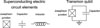 |
FIG 1 (a) Elements of superconducting electric circuits are a Josephson junction, a capacitor and an inductor. A Josephson junction is a superconducting wire interrupted with a thin insulating layer, creating a superconductor-insulator-superconductor junction. A transmon qubit is made of a Josephson junction in parallel with a shunting capacitor. |
The essential concept here is a qubit, a quantum mechanical two-level system. The quantum state of a qubit needs to be highly controllable, measurable and long-lived. In addition to that, qubits need to have on-demand interactions between each other to realize rich quantum operations utilized in computing, communication and sensing applications. To build a good qubit, the old rule ‘the simpler the better’ still holds in many occasions. For example, the most-used superconducting qubit, named as the transmon qubit, is made just of a Josephson junction and a parallel capacitor (Fig 1).
The first qubit quantum state realized in a superconducting electric circuit had only a nanosecond lifetime in 1999 [1]. Over 25 years later, the lifetimes have been pushed to millisecond range [2,3]. Actually, the single qubit lifetimes themselves are not anymore the most limiting factor for the potential of superconducting quantum technologies. The current-day challenge is to implement high-accuracy qubit operations. In practical terms, this means electric control pulses that change the state of qubits. The fundamental reason for the challenge for realizing accurate gate operations is the fact that a quantum state is an analog concept, not discrete, not digital. This means that quantum state amplitudes and phases are continuous variables and they all need to be transformed exactly under qubit operations.
Quantum error correction: Creating a few less-faulty qubits out of many flawed qubits and faulty operations
How to go beyond? Is it just enough to keep improving devices, materials and controls of superconducting circuits and in some point we have good enough qubits and qubit operations? The consensus answer is ‘no’. In addition to material and device engineering, we need to implement also ‘quantum error correction’. This is a software method for actively removing effects of errors from qubits and their operations while simultaneously keeping them fully operational [4].
In quantum error correction, an error-corrected qubit, denoted as the logical qubit, is built out of a physical system that is bigger than just a two-level system. Here bigger means that it has more than two quantum states. The extra states are used to detect errors and recover from their effects. In other words, the system has useful redundancy and structure. This is a bit similar to error correction in regular reading. We can read text despite few errors. Wörds and sentences have strukture which helps detecting possible errors and parsing them without losing essential information. In quantum error correction, useful structure and redundancy are created with entanglement.
Quantum error correction is really challenging to realize in practice for two fundamental reasons. First, it is created by the physical operations that are themselves erroneous. That is to say quantum error correction is a process where one purifies a few less-faulty qubits and operations out of many flawed qubits and faulty operations. The second challenge originates in inherent quantum mechanical properties, especially those related on quantum measurements. The quantum error correction measurements need to be delicately tailored so that they just reveal the effects of errors but nothing about the logical qubit state itself. To realize this one needs to utilize again entanglement.
An error-corrected superconducting circuit-based quantum computer has two types of blueprints that can be described as: (a) first scale-up and then correct, (b) first correct and then scale-up. The difference between them is that what is considered as the big system to create the error-correction in the first place. In the scale-up and correct approach, the big system is a grid of qubits [5]. In the correct and scale-up method, the big system is a resonator and a qubit [6].
First scale-up and then correct?
Let us take a qubit grid that has in total N physical qubits and let us build one logical qubit out of it. The total number of different physical multi-qubit states is 2^N and the basic idea is to choose two of these multi-qubit states as the logical qubit states. It is easy to see that there are many ways of choosing these. What is a good approach then?
First, the physical errors are local. For example, a material defect may accidentally flip a local physical qubit state. The logical qubit states should be chosen so that single localized errors are correctable. In other words, the logical states must have highly non-local character so that local perturbations do not destroy them. Second, errors must be detectable with nearly-local measurements. This restriction comes from the fact that in practical terms it is possible to make physical qubits to interact with other only in short-range. It is practically possible to realize measurements that simultaneously measure common properties of nearby-qubits only.
The scale-up and correct approach is like making a 2D tiling, where there is a non-local tiling pattern representing the logical state and local rule for detecting coloring errors. For example, the local rule can be that four nearby tiles must have even number of different color. To detect errors, here to detect that a color has flipped, it is enough to look nearby-tiles and this measurement does not reveal anything about the non-local tiling pattern, see Fig. 2.
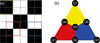 |
FIG 2 (a) Visualization of a 2D tiling where X shape is the non-local tiling pattern. Colored squares visualize different almost-local tile coloring checks: If the parity of colors is even no tiling coloring error has occurred. (b) Schematic of a qubit grid quantum error correction code consisting of seven physical qubits, one logical qubit and three error check “tiles”. |
First correct and then scale-up?
The approach denoted as ‘first correct and then scale-up’ is based on utilizing the quantum eigenstates of a single harmonic oscillator [6]: the ground state |0〉, the first excited state |1〉, the second excited state |2〉,... In theory, a single harmonic oscillator has infinite number of eigenstates, constituting the big system needed for quantum error correction. In practice, though, coherence and controllability limit the number of states to a finite but sufficiently large. Also, in practice, one needs a qubit coupled to the harmonic oscillator to efficiently control and measure the states.
The idea is to construct two logical states out of the eigenstates of the harmonic oscillator. One of the simplest examples is to select the physical states |2〉 and (|0〉+|4〉)/√2 as the logical states [7]. Here it is important to notice that they are made of even parity states. With harmonic oscillator, the dominant error is an energy loss error, that means that the logical states become as the states |1〉 and |3〉 under a loss of single excitation. One notices that the error states are of odd parity. The way to detect if an error has occurred is to measure parity of the physical states, which only reveals whether or not an excitation loss error has occurred but does not distinguish between the logical states or the error states. Parity plays the same role as the non-local structure in the qubit grid states. Similarly as in the qubit grid approach, one can select the logical states in a many different ways, see Fig 3.
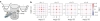 |
FIG 3 (a) Schematic of a cavity (resonator) and a transmon qubit for creating a logical error-correctable qubit. (b) Visualization of different Gottesman-Kitaev-Preskill -type error-correctable logical states. Adapted from B.L Brock et al., Nature 641, 512 (2025). |
Both of the approaches have their strengths and weaknesses. The qubit grid approach, where one first need to scale-up the number of qubits and then correct the errors, provides in theory strong protection against local errors. However, the weaknesses is that one first needs to push the error levels of physical qubits, operations, and measurements to low enough values to benefit on the error correction in large qubit grid [8]. As the number of physical qubits increases also the number of different errors increases. This yields a decoding challenge: How to decide efficiently what was the error that occurred and how to correct it quickly before other errors appear?
The resonator and qubit approach is simple and efficient in hardware. Another positive feature is also that harmonic oscillators have generally much lower intrinsic error rates than corresponding qubits [9]. Also the resonator approach is quite well free from the decoding challenge as its errors are simpler, essentially different number of excitation losses. The main challenges lie in realizing accurate and quick operations and measurements for the resonator logical states.
As in many cases, good solutions can be found by hybridizing, combining the benefits of both approaches. Here it would mean taking an error-corrected resonator as the physical qubit of the qubit grid approach, truly realizing the first correct and then scale-up scenario [10]. Currently several laboratories and quantum technology companies are exploring several variants of these error correction approaches. It will be interesting to see which approach or combination of them is the first one to reach a fully error-corrected and scalable superconducting quantum computer.
About the Author

Matti Silveri leads a research group focusing on theory and modeling of quantum computing and devices based on superconducting electric circuits at the University of Oulu, Finland. He has also worked as a researcher at Yale University, USA and Aalto University, Finland.
Reference
- Y. Nakamura, Yu. A. Pashkin, J. S. Tsai, Nature 398, 786 (1999) [Google Scholar]
- M. Tuokkola et al., Nat. Commun. 16, 5421 (2025) [Google Scholar]
- M. P. Bland, F. Bahrami et al., Nature 647, 343 (2025) [Google Scholar]
- D. Gottesman, An introduction to quantum error correction and fault-tolerant quantum computation, arXiv:0904.2557 (2009) [Google Scholar]
- A. G. Fowler, M. Mariantoni, J. M. Martinis, A. N. Cleland, Phys. Rev. A 86, 32324 (2012). [Google Scholar]
- D. Gottesman, A. Kitaev, J. Preskill, Phys. Rev. A 64, 12310 (2001) [Google Scholar]
- M. H. Michael et al., Phys. Rev. X 6, 31006 (2016) [Google Scholar]
- R. Acharya et al., Nature 638, 920 (2025) [Google Scholar]
- V. V. Sivak et al., Nature 616, 50 (2023) [Google Scholar]
- H. Putterman et al., Nature 638, 927 (2025). [Google Scholar]
All Figures
|
FIG 1 (a) Elements of superconducting electric circuits are a Josephson junction, a capacitor and an inductor. A Josephson junction is a superconducting wire interrupted with a thin insulating layer, creating a superconductor-insulator-superconductor junction. A transmon qubit is made of a Josephson junction in parallel with a shunting capacitor. |
| In the text | |
|
FIG 2 (a) Visualization of a 2D tiling where X shape is the non-local tiling pattern. Colored squares visualize different almost-local tile coloring checks: If the parity of colors is even no tiling coloring error has occurred. (b) Schematic of a qubit grid quantum error correction code consisting of seven physical qubits, one logical qubit and three error check “tiles”. |
| In the text | |
|
FIG 3 (a) Schematic of a cavity (resonator) and a transmon qubit for creating a logical error-correctable qubit. (b) Visualization of different Gottesman-Kitaev-Preskill -type error-correctable logical states. Adapted from B.L Brock et al., Nature 641, 512 (2025). |
| In the text | |
Current usage metrics show cumulative count of Article Views (full-text article views including HTML views, PDF and ePub downloads, according to the available data) and Abstracts Views on Vision4Press platform.
Data correspond to usage on the plateform after 2015. The current usage metrics is available 48-96 hours after online publication and is updated daily on week days.
Initial download of the metrics may take a while.